
The penetration test is complete. The compliance audit has officially concluded. The automated posture scanners have finished their deep sweeps of your cloud and on-premises infrastructure.
And now, you are staring at the result: a 300-page PDF report and an exported spreadsheet outlining every gap, misconfiguration, and vulnerability in your environment. There are 5,000 rows of data.
For IT and security leaders, this exact moment is often the most dangerous part of the entire security lifecycle. The immediate threat isn’t just the vulnerabilities themselves—it is the operational paralysis that inevitably follows.
When you hand an engineering team a spreadsheet with thousands of red and yellow flags, the natural human instinct is to start patching frantically from the top down. But in the complex, highly distributed environments of 2026, treating a massive IT security report like a simple to-do list is a guaranteed recipe for burnout, massive operational friction, and misallocated budget.
If everything is labeled a priority, then nothing actually is.
At KNZ Solutions, we see organizations get trapped in this “whack-a-mole” cycle every day. They spend millions remediating thousands of minor flaws while leaving glaring, systemic architectural gaps wide open. Here is a definitive guide on how high-performing IT leaders stop drowning in data, cut through the noise, and turn massive security findings into a strategic, defensible action plan.

Table of Contents
The Illusion of the CVSS Score
Before you can build an action plan, you have to fundamentally change how you look at the data provided by your vendors and tools.
Most organizations sort their findings by their CVSS (Common Vulnerability Scoring System) severity. They see a “9.8 Critical” assigned to a specific server and immediately scramble their infrastructure and engineering teams to patch it over the weekend.
But a raw technical score lacks the one critical element that actually matters in enterprise IT security: business context.
A “Critical” vulnerability on an isolated, internal test server with no sensitive data and no outbound internet access is not a crisis. It is a maintenance task. Conversely, a “Medium” vulnerability on an internet-facing API endpoint that an autonomous Agentic AI uses to query customer financial records could be catastrophic. Attackers do not care about your compliance scores; they care about the path of least resistance to your most valuable data.
To build an action plan that executives will actually understand and fund, you must stop translating technical flaws into IT problems, and start translating them into business risk.
Step 1: Contextualize and Triage
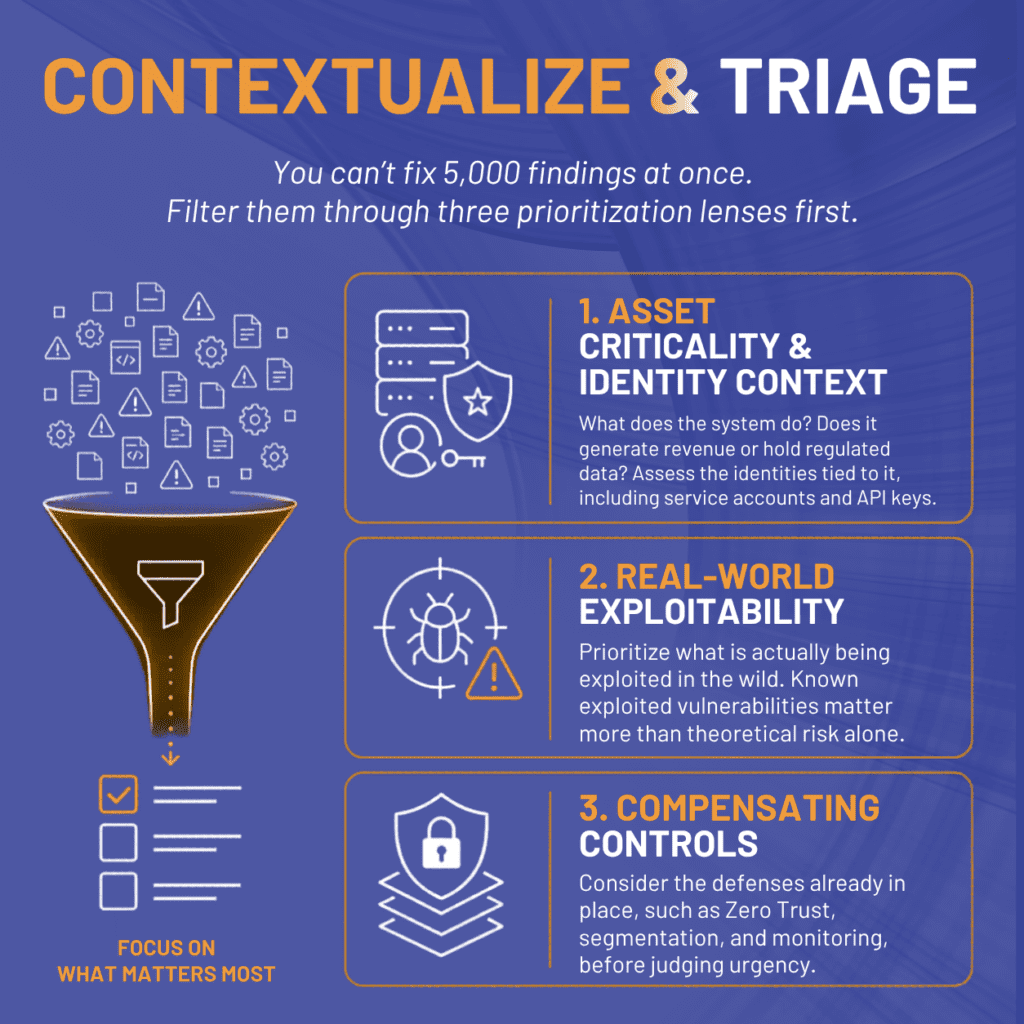
You cannot fix 5,000 things at once, and attempting to do so will only disrupt the business. You have to triage the bleeding first. Modern prioritization requires you to filter your findings through three specific lenses:
- Asset Criticality and Identity Context: What does this vulnerable system actually do? Does it generate revenue? Does it hold regulated healthcare or financial data? Furthermore, you must assess the identities tied to it. In 2026, machine identities (service accounts, API keys) outnumber human users significantly. If a vulnerable server houses the API keys used by your marketing automation platform or your internal Anthropic Mythos deployments, the criticality skyrockets because the blast radius of a breach extends across your entire toolchain.
- Real-World Exploitability: Is this vulnerability just a theoretical proof-of-concept published by an academic researcher, or is it actively being exploited by ransomware gangs in the wild? By cross-referencing your findings with intelligence feeds like CISA’s Known Exploited Vulnerabilities (KEV) catalog, you can instantly filter out the noise. A “High” score that has never been exploited takes a backseat to a “Medium” score that is currently trending on the dark web.
- Compensating Controls: Do you already have defenses in place that neutralize the flaw? For example, a vulnerability might require an attacker to have local network access. If you have already deployed a mature Zero Trust architecture that continuously verifies identity and restricts lateral movement, the actual risk of that vulnerability being exploited drops dramatically. If the front door is heavily guarded and locked, a broken latch on an interior utility closet is less urgent.
Transitioning to an architecture where trust is continuously verified doesn’t happen overnight, but it is the most effective way to shrink your attack surface. If you need a practical roadmap to build these foundational compensating controls, explore our Zero Trust Journey Guide to map your exact path forward.
Step 2: Define the Remediation Strategy
Once you have triaged and contextualized the list, you must decide what to actually do about it. One of the biggest mistakes IT leaders make is assuming every single finding requires a patch. Your action plan should bucket every prioritized finding into one of three distinct tracks:
1. Remediation (The Fix)
This is the standard approach. You apply the software patch, update the firmware, or completely reconfigure the firewall to eliminate the vulnerability at its source. This resource-intensive approach must be strictly reserved for high-risk, actively exploitable flaws on business-critical assets.
2. Mitigation (The Shield)
In enterprise environments, you often cannot patch a legacy system because doing so will break a critical business application or disrupt a delicate CI/CD pipeline. In these cases, you mitigate. You implement stricter network segmentation. You deploy behavioral analytics to watch for anomalous traffic. You enforce stricter, identity-first access controls around that specific asset. You haven’t fixed the underlying code flaw, but you have neutralized the threat vector.
3. Acceptance (The Calculated Risk)
This is often the hardest step for security engineers to swallow, but it is the most vital for business leaders. If a finding has a virtually zero exploitability rate, impacts a non-critical sandbox environment, and would cost $50,000 in operational labor and downtime to fix, the correct business decision is to formally accept the risk. Document it, put a monitoring alert on it, and move your highly paid engineers onto problems that actually threaten the company.
Step 3: Shift from "Whack-a-Mole" to Root Cause Analysis
A mature action plan does not just assign tickets to fix individual symptoms; it identifies and cures the underlying disease.
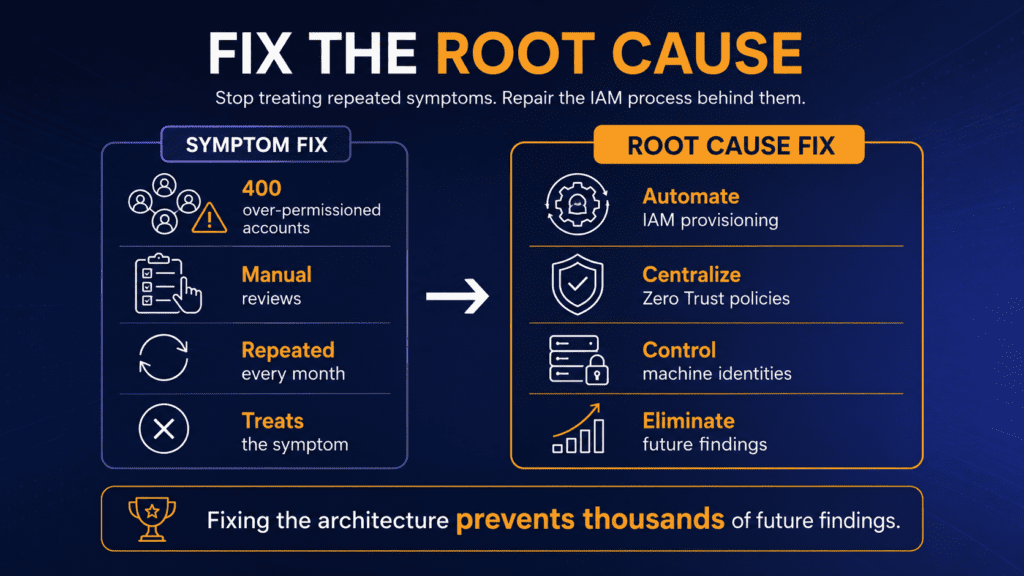
If your audit reveals 400 instances of “over-permissioned user accounts,” assigning a junior engineer to manually restrict 400 individual accounts is a profound waste of time. They will simply reappear next month when new employees are onboarded. The finding is merely a symptom of a broken, manual Identity and Access Management (IAM) provisioning process.
Your action plan must allocate time and budget for root cause architecture updates. Instead of fixing individual CVEs, your plan should advocate for deploying automated lifecycle management for machine identities, or implementing centralized Zero Trust access policies. Fixing the architecture eliminates thousands of future findings before they ever make it onto a compliance spreadsheet.
Step 4: Build the Phased Roadmap
A sprawling, 12-month IT security remediation plan is overwhelming. Executive boards lose interest, and IT teams lose focus. Instead, structure your action plan into distinct, manageable phases that demonstrate immediate Return on Investment (ROI) and operational momentum.
[Phase 1 (Days 1 – 30): The Bleeding Edge] Target the low-effort, extremely high-impact items. This includes disabling unused, highly privileged service accounts, enforcing MFA across all external and internal portals, and patching the top known exploited vulnerabilities on your internet-facing assets. This phase is about immediate risk reduction and proving the value of the assessment.
[Phase 2 (Days 30 – 90): Strategic Mitigations] Tackle the architectural gaps that require cross-departmental coordination. This is where you begin segmenting flat legacy networks, reviewing third-party vendor API access, applying strict guardrails to your Agentic AI workflows, and optimizing the security tools you already own to ensure they are communicating context to one another.
[Phase 3 (Days 90+): Long-Term Transformation] Address the heavy lifting that requires capital expenditure and major operational shifts. This includes transitioning legacy encryption to Post-Quantum Cryptography (PQC), rolling out a comprehensive identity-first Zero Trust framework, or decommissioning legacy infrastructure that is no longer viable to secure.
The Leadership Pivot: Communicating the Plan
When it is time to present your action plan to the executive board or the CEO, leave the CVE numbers, CVSS scores, and technical jargon at the door.
Executives do not care about port misconfigurations or lattice-based cryptography algorithms. They care about financial exposure, regulatory fines, operational downtime, and brand damage. Your action plan must be framed entirely around business risk reduction.
You are no longer saying, “We need $150,000 and 400 hours of labor to patch 200 servers.”
Instead, you are saying, “We have identified a critical gap that exposes our core customer database and our primary billing application. This phased action plan reduces that specific operational risk by 85% over the next 60 days, ensuring we remain compliant and avoid any disruption to our revenue streams.”
That clarity completely changes the dynamic of the conversation. Security transitions from being viewed as a costly, frustrating roadblock into a strategic, measurable business investment.

Execution Requires the Right Partners
An action plan is ultimately only as good as the tools, architecture, and partners you rely on to execute it. You cannot mitigate complex, 2026-era threats with legacy vendors who are completely out of touch with the realities of distributed networks and autonomous technologies. As you move from the planning phase into execution, you must ensure that your underlying IT security stack is actually capable of supporting your new, dynamic roadmap.
Are you ready to stop admiring the problem and start fixing it? Do not let your next vendor lock you into a rigid platform that fails to align with an identity-first strategy. Download our free IT Security Vendor Evaluation Scorecard today to objectively grade your options side-by-side, cut through the aggressive marketing noise, and select the partners who can actually turn your action plan into a resilient reality.
Related Articles:
About the Author:

KNZ Solutions is a systems integrator that provides strategic IT advisory and infrastructure expertise. We help organizations modernize their technology environments, strengthen security and data governance, and gain greater visibility into the systems that power their business.


