

As Artificial Intelligence continues to advance, its capabilities in the form of writing working code have continued to increase with both complexity and accuracy with each passing month. We are no longer dealing with AI tools that can only write basic python scripts and functioning web applications but are now dealing with the threat of tools which are highly advanced and intelligent, and can cause very real harm in a small amount of time. Tools such as Claude Mythos and open-source uncensored Deep Seek models are not only capable of writing highly effective malicious software and malware, but are furthermore being used by independent actors and nation-states to actively create and implement zero-day vulnerabilities across a wide array of commonly used network and security appliances at a rate that we simply have not seen before.
For CISOs, Network Security Architects, and Security Engineers the traditional vulnerability management lifecycle of periodic patching windows which are reliant on CVE disclosures are no longer an adequate approach to keep your network and your appliances protected. Zero-Day attacks and vulnerabilities have always posed a major risk to organizations, however now the speed and frequency of these types of CVEs has increased by a magnitude and will continue to increase at rates never seen before.
When it takes vendors weeks or more to address a vulnerability that can be created and deployed in mere hours, the question on many peoples’ minds is, “How do we actually protect our networks from these new types of attacks?”. There are several potential solutions, but they do require a shift in how we think about and address network security organization-wide. Some of these may already be familiar to you, while some of these are relatively new to the industry, however it’s all about building a strong foundation following these four key pillars:
AI
Detect faster
Reduce blast radius
Disrupt automation
Could Your Defenses Keep Up With an AI Powered Attack?
Answer five short questions to uncover how prepared yourenvironment is to detect, contain, and disrupt automated cyberattacks.
Question 1 of 5
20% complete
Assessment complete
0%
Readiness stage
Recommended next resource
Recommended resource
Your recommended resource will appear here with guidance tailored to your score.
◎
Analyzing your defenses
Calculating readiness and matching your next resource...
Table of Contents
1. Zero Trust and Hardened Micro-segmentation
The concept of a trusted internal network has been obsolete for several years now. The concept of “Never Trust, Always Verify” needs to become a key pillar that your organization is working towards implementing. By enforcing strict micro-segmentation at the workload and application levels, lateral movement can be severely limited and the attack can be identified and stopped before it becomes deeply embedded across your network and applications.
If an AI agent or a malicious actor compromises a single node or identity, by limiting its movement this gives us adequate time to quarantine that machine, identify the attack vector, and stop it before the issue becomes more widespread. Continuous authentication and authorization—evaluating identity, device posture, and behavioral context for every single API call are becoming a mandatory security requirement for the next generation wave of network architectures. A wide variety of solutions and tools are available which can accomplish this type of configuration, and it’s important to consider what works best with your particular environment, workflows, and applications, so that this type of solution can be implemented safely, and without causing too much of an administrative overhead for the teams managing it.
2. Machine-Speed Autonomous Defense
Fighting an army of automated AI adversaries with a small pool of human analysts triaging alerts via a SIEM will quickly become a losing battle as these types of AI-based attacks continue to become more widespread and are now being targeted and tailored towards specific organizations. What’s the answer then? For better or for worse, that means fighting AI with AI to be blunt.
Examples of this include next-generation tools such as:
NDR
Network Detection and Response uses machine learning to analyze network activity and uncover threats that traditional rules may miss.
EDR
Endpoint Detection and Response identifies malicious activity and can isolate affected devices before an attack spreads further.
UEBA
User and Entity Behavior Analytics learns how users and systems normally operate so suspicious deviations can be identified earlier.
Agent
Agentic security features can evaluate risk and initiate predefined actions without waiting for every step to be handled manually.
Here, it’s all about establishing a baseline of what constitutes normal operations and administrative functions over several months so that these systems have a thorough understanding of what types of actions are considered acceptable versus which types of actions are potentially malicious. When an identity or workload deviates from these baselines by executing unusual administrative commands or querying unexpected data volumes, the defensive infrastructure needs to be able to isolate the asset quickly, without waiting for human intervention.
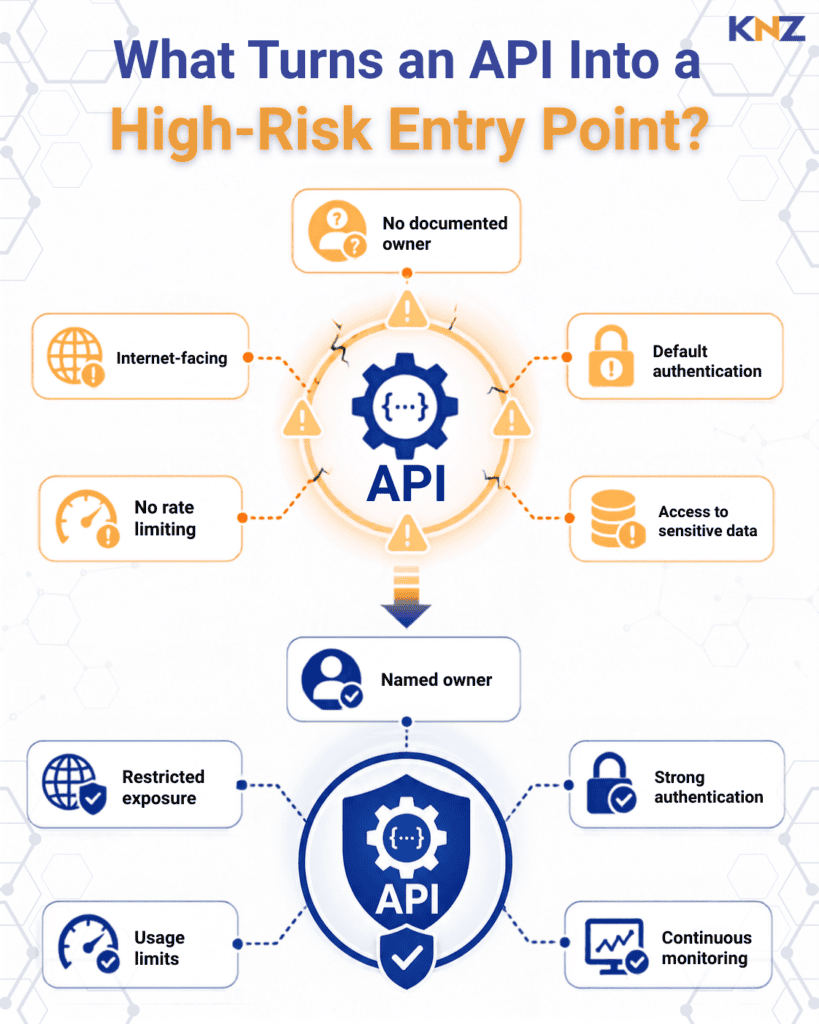
3. API Governance and Identity Security
APIs in the past decade have become more commonplace amongst not only every single network and security vendor, but also nearly every single locally-hosted as well as cloud application that your organization may be using today.
Unfortunately for us, AI tools excel at mapping and exploiting undocumented, shadow, or poorly secured APIs. In some cases, it’s as simple as a product being deployed which happens to have an API, that was never used and left at default settings. In other cases, the API could be fully functioning and used daily, but the security configuration was never reviewed or audited after being migrated from the test environment onto the production environment because the existing configs ‘simply worked’.
Implementing comprehensive API discovery, strict schema enforcement, and aggressive rate limiting are critical to preventing automated data scraping and exploitation. Furthermore, we need to think of identity as the new perimeter. Enforcing phish-resistant MFA solutions and implementing just-in-time (JIT) access for privileged and non-human identities severely limits the attack surface available to automated reconnaissance.
Sometimes, simply starting with identifying each tool that has an API, and documenting it is a great first step – It’s better to disable these features if possible and then to only enable them at a later date when their security posture and configuration have been fully hardened and validated.
4. Active Defense and Deception Grids
Passive defense allows an AI to map your network at its leisure, and today’s tools, scripts, and basic agents are highly effective at doing this, even when given limited instructions and information from the malicious actor. However, we can easily exploit this weakness in the same way that prompt engineering can be used to bypass an AI’s built-in safeguards.
What does that mean?
[Hover mouse for answer]
Deploying technology that actively deceives and muddies the water with fake or bad data is a great start, as most AI agents and LLMs have no way of differentiating between valid targets and fake traps.
This means deploying things such as high-fidelity honeypots, honey tokens, and even purposely leaving fake administrative credentials in memory to actively deceive and catch a malicious AI or agent in the act, before it actually gets a chance to steal legitimate credentials or device access. This effectively turns the AI’s exploratory nature against it. Automated scanning tools will inevitably interact with these decoys, triggering immediate, high-confidence alerts that expose the attacker’s presence and methodologies early on in the kill chain.
Closing Comments
While following the four security pillars mentioned above may sound great on paper, I think a lot of leaders and engineers would likely agree that it’s a lot easier said than done. So where do we start then, and how do we take those initial steps in the right direction without being paralyzed by the prospect of a 3-year long security architecture transformation?
Protecting a real-world enterprise doesn’t require a total architectural overhaul on day one. Instead, focus on low-overhead, immediate wins: auditing and disabling unused APIs, planting basic honeypots/tokens in memory, overhauling or implementing DNS Sinkhole servers, or strictly locking down your single most critical application workload. This might be the perfect time to POC a new potential security tool with a vendor to do so, which will let you prove out the benefits prior to committing to a large investment. And even before then, looking to leverage your existing tools to their full capacity and feature set is a great starting point, as we find that organizations have often already paid for many features or services that they are not currently using, and could be implemented swiftly with minimal cost.
The first step I’d reccomend taking is understanding where your most significant gaps exist today. You can download our Network Security Self-Assessment to evaluate your current controls, identify priority areas, and determine the next actions that can have the greatest impact on your security posture. By focusing on achievable improvements now, your organization can move away from a reactive approach and begin building a more resilient network.
Related Articles:
About the Author:

Zack Benjamin is the Principal Architect at KNZ Solutions, where he serves as a key technical leader overseeing engineering teams and designing customer-focused network and security solutions. With more than 17 years of experience in data center infrastructure, networking, and cybersecurity, he has held engineering leadership roles across several Fortune 500 companies and has spent over seven years in engineering and architecture positions at KNZ. Zack works closely with clients and internal teams to scope complex environments, identify risks, close technical gaps, and ensure solutions align with business goals before deployment. His experience with AI tools, machine learning, scripting, and automation also enables him to help organizations evaluate and integrate emerging technologies within today’s rapidly evolving IT landscape.


