
In the rapidly shifting landscape of 2026, a security review can no longer be a simple “check-in-the-box” exercise. At KNZ Solutions, we have observed a growing disconnect between traditional auditing methods and the reality of modern, AI-driven infrastructure. While many organizations believe their annual reviews are comprehensive, the rise of autonomous agents, quantum-era threats, and sprawling machine identities has created new blind spots that legacy reviews often miss.
An effective review must look beyond surface-level compliance to evaluate the actual resilience of the environment. If the methodology hasn’t evolved to account for the complexities of a “Sense, Think, Act” world, then the resulting report is essentially a map of a city that no longer exists.
Below are the five most common gaps we currently see in security reviews and how organizations can move toward a more robust, future-ready posture.
1. The Quantum "Harvest Now, Decrypt Later" Blind Spot
Perhaps the most significant gap in 2026 is the failure to assess cryptographic risk through a post-quantum lens. Most reviews focus on whether current encryption standards (like RSA or ECC) are correctly implemented. However, they frequently overlook the Harvest Now, Decrypt Later (HNDL) threat, where adversaries intercept encrypted data today with the intent to decrypt it once quantum computing matures.
A review that doesn’t include a “Cryptographic Bill of Materials” (CBOM) is fundamentally incomplete. Organizations need to know not just that their data is encrypted, but how it is encrypted and what the shelf-life of that data is. If sensitive financial or healthcare data is protected by legacy algorithms, it is effectively already compromised in a long-term sense.
Transitioning to Crypto-Agility Examples:
- Auditing data sets with long-term sensitivity (10+ years).
- Inventorying all internal and third-party cryptographic libraries.
- Developing a phased migration plan to NIST-standardized PQC algorithms.
2. Neglecting Machine Identities in the Zero Trust Framework
While identity has become the new perimeter, most security reviews still focus heavily on human users. We see rigorous audits of employee MFA and password policies, yet the “machine identities”—API keys, service accounts, and automated bots—are often left in the shadows. In 2026, machine identities outnumber human users significantly, and they are often far more privileged.
A common gap is failing to assess the lifecycle management of these non-human entities. In a Zero Trust environment, every API call and service interaction must be verified with the same scrutiny as a human login. reviews often miss hard-coded credentials in CI/CD pipelines or service accounts with “set-it-and-forget-it” permissions that allow for massive lateral movement during a breach.
Identity Governance Examples:
- Implementing automated secret rotation for service accounts.
- Applying “least-privilege” access specifically to machine-to-machine APIs.
- Integrating behavioral analytics to detect anomalies in bot traffic.
3. Assessing AI Models Without Auditing Agentic Permissions
With the industry moving from Generative AI to Agentic AI, reviews have struggled to keep up. Many reviews focus on the safety of the AI model itself—ensuring it doesn’t generate toxic content—but they miss the security of the Agentic Workflows. Agentic AI is designed to act on its own, calling tools and executing multi-step tasks across the network.
The gap lies in failing to audit the boundaries of what these agents are allowed to do. If an AI agent has the authority to update a database or modify a network configuration, does it have the necessary guardrails to prevent a “jailbreak” from becoming a catastrophic system failure? Security reviews must now evaluate the “Human-in-the-Loop” requirements and the execution boundaries of these autonomous operators.
Agentic Guardrail Examples:
- Restricting agent access to sensitive “write-access” tool endpoints.
- Auditing the prompts and context-windows for potential prompt-injection risks.
- Establishing hard spending and resource-usage caps for autonomous agents.

4. Surface-Level Third-Party and Supply Chain Vetting
The days of relying on a simple vendor questionnaire are over. In 2026, third-party and supply chain breaches have doubled, primarily because reviews often stop at the organization’s front door. A major gap is the lack of visibility into the “Nth-party” risk—the vendors that your vendors use.
Modern reviews must delve into the interconnectedness of the software supply chain. This includes vetting open-source dependencies and the security of the APIs used for integrations. If a review doesn’t look at the security posture of the cloud interfaces and the integrity of the code being pulled into your environment, it is ignoring the most common entry point for modern ransomware operations.
Supply Chain Resilience Examples:
- Implementing real-time vendor risk monitoring instead of annual reviews.
- Scanning software builds for vulnerabilities in third-party libraries.
- Enforcing strict security compliance clauses in all partner integrations.
5. Overlooking the Fragility of Physical Infrastructure
Finally, many digital security reviews completely ignore the physical infrastructure that sustains the network. As AI workloads drive data center rack densities to new heights, the cooling and power systems have become critical security dependencies. An review that ignores the resilience of the HVAC or the power microgrid is missing a massive operational risk.
If a data center’s cooling system fails due to the heat generated by a high-density GPU cluster, the resulting downtime is just as damaging as a DDoS attack. We have seen that AI-ready environments require a fundamental shift in how we assess physical uptime. Assessing the security of the physical environment, including AI-driven building management systems, is now essential for maintaining a secure and reliable operation.
Infrastructure Resilience Examples:
- Evaluating the redundancy of liquid-cooling loops for AI clusters.
- Testing the transition time to on-site microgrids during power fluctuations.
- Assessing the cybersecurity of the Industrial Internet of Things (IIoT) sensors managing the facility.
Closing the Gap
Security in 2026 is about more than just having the right tools; it is about having a strategy that accounts for the complexity of an interconnected, autonomous world. A gap in your review today can lead to an insurmountable crisis tomorrow. Whether it is preparing for the post-quantum future or securing the next generation of AI agents, the key is to move from a reactive posture to a proactive, resilience-focused mindset.
At KNZ Solutions, we specialize in identifying these hidden risks and helping organizations build a mathematical bedrock for their security. We believe that a review should be the beginning of a transformation, not just a document for the archives.
Are you ready to see the real state of your security?
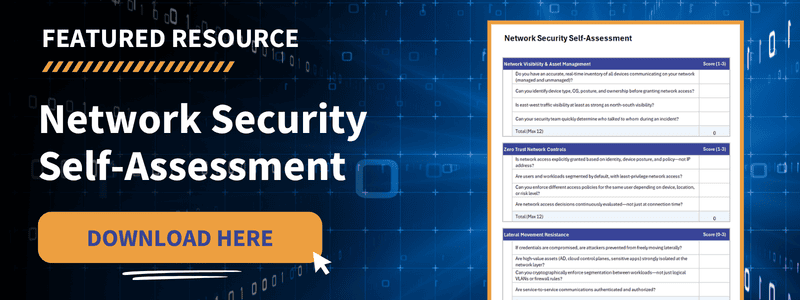
Take our Network Security Self-Assessment today to evaluate your current defenses and uncover the critical gaps hiding in your 2026 network infrastructure.
About the Author:
KNZ Solutions is a systems integrator that provides strategic IT advisory and infrastructure expertise. We help organizations modernize their technology environments, strengthen security and data governance, and gain greater visibility into the systems that power their business.


