
Let’s be brutally honest: for years, “Zero Trust” felt more like a whiteboard thought experiment than a practical strategy. It was the conceptual utopia of how an organization should secure its data.
But welcome to 2026. The whiteboard has been wiped clean, and those theoretical debates are officially over. The traditional network perimeter is completely dead. Driven by the explosion of autonomous AI agents executing rapid enterprise workflows, wildly distributed network environments, and the fast-approaching threat of quantum computing. Building a Zero Trust architecture isn’t just a best practice anymore—it is the baseline for survival.
At KNZ Solutions, we believe it is time to stop talking in hypotheticals and start building. To effectively protect your enterprise today, you need a clear, operational reality check. Here is a candid, no-nonsense look at what a Zero Trust architecture actually means in production right now—and just as importantly, what it doesn’t.

What Zero Trust IS NOT in 2026
To understand the modern reality, we must first end a few persistent myths.
It is NOT a Product You Can Buy
There is no such thing as “Zero Trust in a Box.” You cannot buy a single software license, install it, and suddenly achieve a Zero Trust architecture. It is not a SKU; it is a foundational security framework and a methodology. If a vendor tells you their single application will make you “Zero Trust compliant,” they are selling you snake oil.
It is NOT Just a Shiny VPN or a One-Time MFA Prompt
For a long time, organizations thought that if they forced users to authenticate via Multi-Factor Authentication (MFA) before logging into a secure tunnel, they had achieved Zero Trust. In 2026, access is no longer a one-time login event. Passing an MFA check at 8:00 AM does not mean the system should implicitly trust that connection at 10:00 AM.
It is NOT Designed to Slow Down Productivity
A commonfear among executives is that Zero Trust will create so much friction that employees won’t be able to do their jobs. In practice, the goal isn’t to slow people down. Modern Zero Trust operates silently in the background, analyzing context. When implemented correctly, it actually streamlines the user experience for legitimate behaviors while instantly throwing up roadblocks for anomalous ones.
What Zero Trust ACTUALLY IS in 2026
So, if the perimeter is gone and the marketing buzzwords are stripped away, what is the operational reality?
1. Identity is the Only Perimeter That Matters
This year, you will witness that the traditional network perimeter is dead. Applications are everywhere, users are working from everywhere, and data moves across environments constantly. In this sprawling reality, identity becomes the only perimeter that matters.
2. Trust is Continuous and Context-Aware
Security has shifted entirely to “Context-Aware” access. Trust is no longer based merely on your password; it is granted based on who you are and what you are doing in real-time. Modern systems continuously evaluate a complex matrix of signals before and during every interaction:
- Who the user is
- What they are trying to do
- The device’s health and security posture
- Location and specific risk indicators
- Whether the current behavior matches what “normal” looks like for that user
3. The Ultimate Goal is Blast-Radius Containment
We have to accept the reality that breaches will happen; credentials will be phished, and mistakes will be made. The true power of Zero Trust in 2026 is its ability to contain the damage. If identity is verified continuously, and access is right-sized dynamically, a stolen credential becomes a contained incident—not an enterprise-wide crisis. By compartmentalizing the network, you prevent threats from moving laterally between systems.
4. It is the Guardian of the Quantum Transition
Zero Trust does not exist in a vacuum; it is deeply intertwined with the transition to Post-Quantum Cryptography (PQC). PQC provides the essential mathematical shield for your data, but it must be integrated into a broader, dynamic security strategy that assumes no user or device is trustworthy by default .
If your organization is upgrading encryption standards to withstand quantum threats, you must also ensure that the foundational systems responsible for verifying identities are equally resilient. It is not enough to simply lock the door with stronger encryption; you must also rigorously validate who holds the key. PQC protects the integrity of the data, but the broader Zero Trust architecture protects the access to it. By combining these two frameworks, you guarantee that adversaries are met with continuous layers of verification and strict access controls that limit their reach.

The Reality Check
The hard truth of 2026 is that your network’s interior is no safer than the public internet. Zero Trust is no longer a theoretical exercise or a project you simply “finish”—it is a mandatory, continuous state of operational readiness. It demands a hard pivot away from the outdated “trust, but verify” model to an architecture built on absolute, context-driven verification for every single interaction.
At KNZ Solutions, we don’t deal in hypotheticals; we engineer security for the real world. Defending your enterprise against autonomous AI agents, fragmented hybrid environments, and the looming quantum threat requires a mathematically sound, identity-first foundation—not a patchwork of disconnected software.
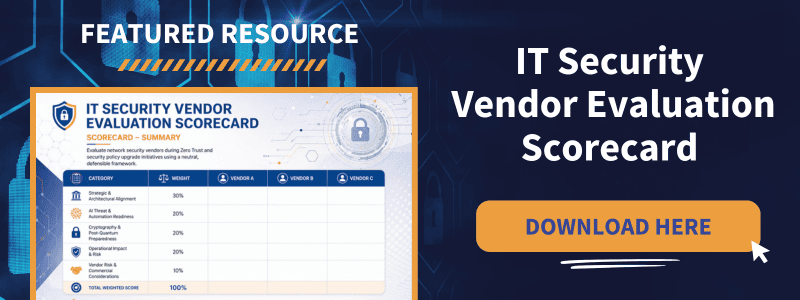
But finding the right technology partner to build that foundation is difficult. The market is saturated with vendors claiming to sell “Zero Trust,” making it nearly impossible to separate genuine architectural capability from aggressive marketing. Don’t base your defenses on a sales pitch. Download our IT Security Vendor Evaluation Scorecard today to objectively assess your options, filter out the noise, and ensure your next investment delivers battle-tested protection.
About the Author:

KNZ Solutions is a systems integrator that provides strategic IT advisory and infrastructure expertise. We help organizations modernize their technology environments, strengthen security and data governance, and gain greater visibility into the systems that power their business.


