
If you asked an IT leader a few years ago what “IT modernization” meant, the answer was highly predictable: migrate everything to the cloud, buy faster switches, and perhaps deploy a standard AI chatbot.
But as we navigate the realities of 2026, the definition of IT modernization has been fundamentally rewritten. At KNZ Solutions, we have seen that the goalposts haven’t just moved; they are on a completely different playing field. Today, enterprise modernization is no longer about blindly adopting the newest tools. It is a holistic transformation—building resilient, highly efficient foundations capable of supporting intense computational demands, autonomous workflows, and quantum-era threats.
Rather than a checklist of disconnected upgrades, a truly modernized IT infrastructure today is a cohesive system built across four critical layers.
The Physical Foundation
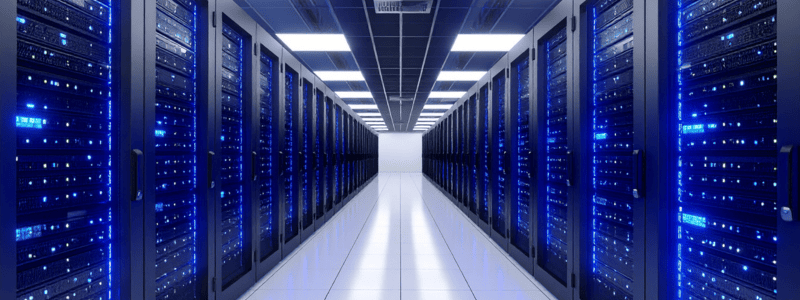
For decades, the primary constraint on data center expansion was physical real estate. In 2026, the limiting factor is no longer ambition or space—it is heat and power. The massive surge in AI compute requirements has completely forced a redesign of the modern facility.
IT modernization at this level means accepting that the days of relying solely on traditional air cooling are over. AI-ready environments are pushing rack densities far beyond what standard HVAC systems can handle reliably, making Direct-to-Chip liquid cooling a mandatory design standard for GPU-heavy clusters.
Furthermore, because these advanced workloads do not tolerate interruptions, modernized data centers are evolving into their own energy strategists. Forward-thinking organizations are no longer totally reliant on a stressed public grid; instead, they are integrating on-site generation, energy storage, and microgrids to stabilize their power supply and fiercely protect their uptime.
The Digital Footprint
The “cloud-first” momentum that defined the early 2020s has matured into a much more nuanced, mathematically driven approach. In 2026, the cloud is not a single destination, but a strategic portfolio.
Enterprise leaders are taking a hard look at their steady-state workloads and asking: Are we renting what we should own? This has sparked the “Great Repatriation,” where roughly 80% of enterprises plan to move specific systems back on-premises or into colocation facilities to regain pricing leverage and performance control. IT modernization means employing a “Smart Hybrid” strategy—optimizing placement so each workload lands exactly where it is most efficient.
Simultaneously, the cloud ecosystem has diversified. For high-performance GPU compute, modernized organizations are turning to specialized “Neoclouds”—providers built specifically for AI workloads that offer the massive scale required for training and high-throughput inference without the bloat of general-purpose hyperscaler services.
The Connective Tissue
Enterprise networks have become far too complex and critical to rely on a “change and pray” approach. With distributed branches, remote users, and zero tolerance for downtime, modernized IT teams now utilize Network Digital Twins. These living, virtual replicas of the network topology allow engineers to simulate the impact of a firewall policy tweak or a routing update in a safe environment before it ever touches production. When physical upgrades do happen, Wi-Fi 7 is the default standard, chosen not just for raw speed, but for the ultra-low latency required by AR/VR training and real-time collaboration.
But a modern network is useless if its security is rooted in the past. In 2026, the traditional perimeter is dead. Modern Zero Trust is entirely “Identity-First”—meaning trust is granted continuously based on real-time signals like device health and behavioral anomalies, ensuring that a stolen credential remains a contained incident rather than a global crisis.
Beneath that identity layer lies an even more pressing reality: Post-Quantum Cryptography (PQC). Because adversaries are currently harvesting encrypted data to crack when quantum computers mature, a modernized security posture treats encryption as a dynamic inventory. Organizations are actively building “crypto-agility,” giving themselves the ability to swap cryptographic algorithms seamlessly without ripping apart their critical systems.
The Autonomous Engine
Finally, a modernized IT infrastructure in 2026 is one where Artificial Intelligence does actual work. We have moved beyond Generative AI that simply drafts emails to Agentic AI—autonomous agents that interpret goals, break them into multi-step actions, and call upon internal tools to finish the job. These agents are effectively becoming the new “middleware” of the enterprise, automating end-to-end workflows in IT operations, customer support, and procurement.
To support these split-second, autonomous decisions, processing is being pushed to the “Intelligent Edge.” By analyzing data directly on the factory floor, in the hospital, or at the retail store, organizations are achieving millisecond latency, slashing bandwidth costs, and ensuring operational resilience even if centralized cloud connectivity drops.
Outcomes Over Components
Ultimately, IT modernization in 2026 is defined by a shift in how we buy and deploy technology. Successful enterprises are no longer investing in individual licenses, features, or modules; they are practicing Outcome-Driven Tech Adoption. They invest in measurable business results – reduced time-to-resolution, faster onboarding, and lower infrastructure costs per workload. After all, if the outcome isn’t defined, the purchase is just hope with a budget.
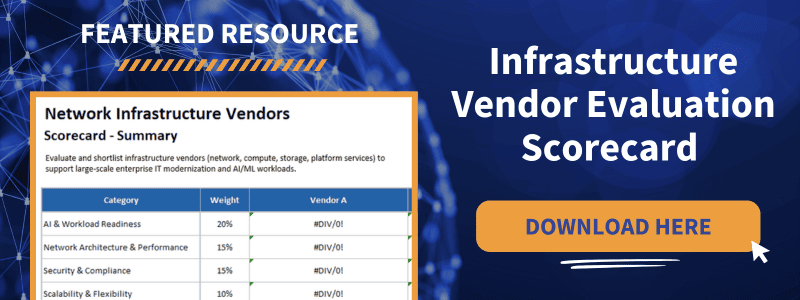
A modernized enterprise requires more than just a vision; it requires the right partners to execute it. Before you make your next strategic investment, ensure the solutions you are evaluating can actually support the intense demands of AI readiness, hybrid workloads, and continuous security. Download our Network Infrastructure Vendor Evaluation Scorecard today to objectively assess your options, cut through the noise, and build your 2026 architecture on a foundation of proven capability.
About the Author:
KNZ Solutions is a systems integrator that provides strategic IT advisory and infrastructure expertise. We help organizations modernize their technology environments, strengthen security and data governance, and gain greater visibility into the systems that power their business.


