
If you’ve sat through a modernization assessment that produced a slide deck full of recommendations tied to that vendor’s product portfolio — nothing you didn’t already know, no prioritization, no sequencing logic — your skepticism is earned.
That experience is common enough that “assessment” has become a word that triggers caution in financial services IT. And that caution is reasonable. But it shouldn’t apply equally to every engagement. There’s a meaningful difference between an assessment designed to generate a sales opportunity and one designed to document your environment honestly enough to be operationally useful.
The output tells you which one you got.
Table of Contents
What a Legitimate Assessment Actually Produces
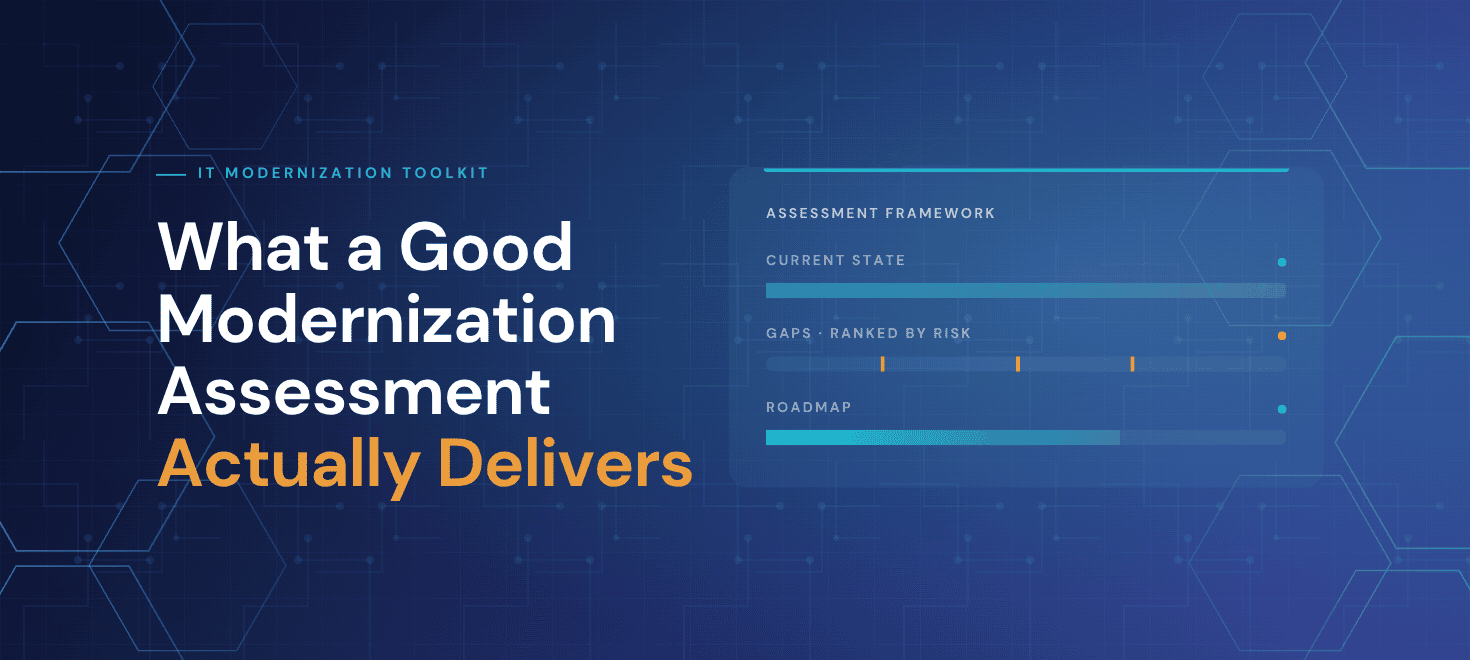
A useful modernization assessment delivers specific artifacts — not observations, not opinions, not a vendor roadmap dressed as independent advice.
An accurate current-state inventory. Not pulled from documentation that hasn’t been updated in three years, but from direct observation of what’s actually running, what version, what its dependencies are, and where the gaps between documented and actual state exist. If the assessment doesn’t start here, everything downstream is built on assumptions.
Gaps ranked by risk and operational impact. Not a list of everything that could be improved. A prioritized view of what matters given your uptime requirements, your audit obligations, and your actual threat surface. Severity should be tied to consequence — what breaks, what gets exposed, what fails audit — not to CVSS scores in isolation or to a vendor’s interest in a particular remediation.
A dependency-aware roadmap. Sequencing work based on what blocks what. Not a wish list sorted by cost or effort, but an order of operations that accounts for which changes require other changes first, and which ones introduce compounding risk if done out of sequence. In mid-market financial services environments, this matters enormously — a change that looks contained rarely is.
A resource and constraints assessment. What your team can realistically absorb, where outside support is needed, and what staffing or knowledge gaps would prevent successful implementation even with a sound technical plan. Assessments that ignore team capacity produce roadmaps that sit on shelves.
Audit-ready documentation. Output that is structured and formatted to be useful when you need to demonstrate compliance posture, explain architectural decisions to an examiner, or support a board-level conversation about modernization investment. If you can’t hand the report to your compliance team and have it be useful, it wasn’t built for your organization — it was built for the firm that produced it.
"A good assessment documents reality. A bad one documents opinions dressed as recommendations."
— KNZ Solutions
Red Flags That Tell You an Assessment Won't Deliver
Before you commit time and access to an assessment engagement, look for these signals:
Recommendations appear before the data collection phase is complete
Every identified gap leads to the same vendor’s product as the solution
No prioritization methodology is explained — gaps are listed, not ranked
The roadmap sequences work by cost or by the vendor’s delivery capacity, not by technical dependencies
There’s no acknowledgment of your team’s capacity to implement what’s being recommended
You’re asked to accept a final report you can’t take with you or share internally
The engagement timeline is too short to include direct observation of your environment
Any one of these is worth a direct conversation before the engagement proceeds. Most reputable firms will welcome the question. The ones that don’t are telling you something.
What You Should Walk Away With
A good assessment gives you three things you can actually use: a clear picture of your current state grounded in direct observation, a gap analysis ranked by what matters to your organization specifically, and a roadmap that sequences work in an order your environment and your team can support.
It should be something you can share with your leadership to build the case for modernization investment. Something you can hand to your compliance team to support audit preparation. Something you can use with an implementation partner — or with your own team — to execute against without starting over.
If the output doesn’t do those things, it wasn’t an assessment. It was a sales tool with a professional services wrapper.
At KNZ Solutions, our assessments are built to be operationally useful — not to generate a proposal. If you’re navigating conflicting vendor guidance or need a credible independent picture of your environment before committing budget, we’re glad to talk through what that looks like.

Related Articles:


About the Author:
KNZ Solutions is a systems integrator that provides strategic IT advisory and infrastructure expertise. We help organizations modernize their technology environments, strengthen security and data governance, and gain greater visibility into the systems that power their business.


