
One thing we have collectively learned over the last few years at KNZ Solutions is that technology is always evolving at a pace that can feel breathless. We used to say we’d have to reinvent our strategies every five years, but now it feels like it’s happening every two. As we navigate 2026, the conversation has shifted from simply “having an AI strategy” to choosing between two very different philosophies of implementation: Generative AI and Agentic AI. We’ve seen many organizations rush to embrace the newest tools without first defining what they hope to achieve, leading to what we call “AI-washing,” where the term becomes more of a marketing badge than an actual driver of business value.
The fundamental choice facing leadership today is whether you need a system that can talk or a system that can act. Generative AI has undoubtedly transformed the way we handle content, but Agentic AI represents a new frontier that moves from “copilot” to “agent”. In our experience, understanding the nuances between these two is critical for any organization looking to move from concept to measurable results.

Defining the Players: The Creative vs. The Proactive
To have an informed conversation about your AI roadmap, we have to move past the buzzwords and look at the functional differences.
Generative AI: The Master of Content
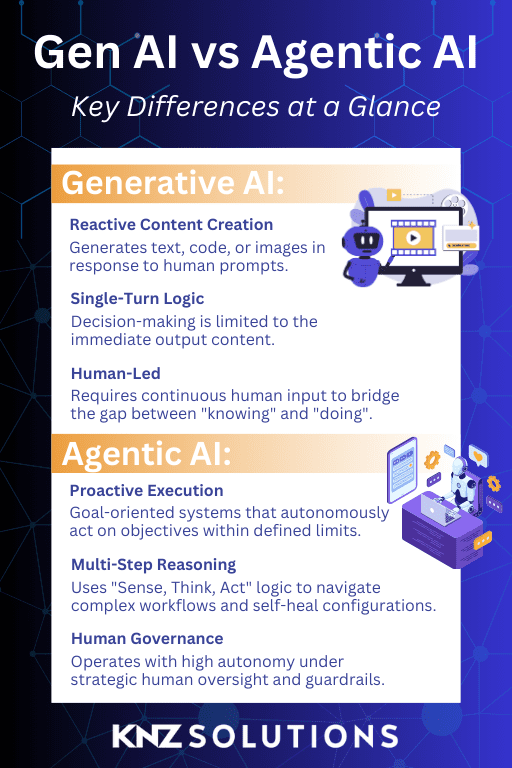
Think of GenAI as your organization’s most creative and efficient assistant. It is fundamentally reactive. It waits for a human to provide a prompt, analyzes its vast training data, and then creates something new—a draft, a line of code, or a summary. Its strength lies in its ability to understand and generate human language at scale.
- Usage Examples: Drafting communications, summarizing data lakes, creating initial code for network solutions, and streamlining documentation.
Agentic AI: The Autonomous Professional
Agentic AI is the evolution of AI from “copilot” to “agent.” While GenAI writes the refund email, Agentic AI is the system that checks the tracking number, verifies the return in the warehouse, updates the CRM, and then initiates the refund—all without you having to prompt it for every step. It is proactive, goal-oriented, and capable of multi-step reasoning.
- Usage Examples: Autonomous network monitoring, real-time threat remediation, supply chain coordination, and end-to-end workflow automation.
The Infrastructure Reality: Power, Cooling, and Data Center Design
We cannot discuss these advanced AI models without addressing the physical reality of the data center. Implementing Agentic AI at scale places significant demands on your infrastructure that many organizations overlook. We have seen studies indicating that AI can drive a 160% to 200% increase in power demands. A single AI query can consume ten times more electricity than a simple internet search. This concentration of power—moving from CPUs that consume 65 watts to GPUs that can range up to 1,000 watts—creates thermal challenges that traditional air-cooling simply cannot meet.
At KNZ, data centers are our bread & butter, so we advocate for a fundamental rethink of data center architecture to support these workloads. This includes moving toward advanced cooling technologies like liquid cooling and AI-enabled HVAC solutions that can dynamically adjust cooling based on real-time server loads. Ensuring your infrastructure is future-ready is a critical step; without a robust foundation, the use of Agentic AI (or even Generative AI) can lead to power shortages and costly downtime. To help you navigate these significant environmental and performance shifts, we have developed a clear roadmap for creating a truly resilient environment. We invite you to explore the full technical benefits and strategic drivers in our resource, “6 Reasons to Modernize Your Data Center Network,” to learn how to prepare your infrastructure for the evolving demands of the AI era.
Where the Real Value Lies: Use Cases for 2026
We often advise our clients to define the problem statement first and work backwards. Here is how these two technologies are currently reshaping the enterprise landscape:
1. Network Operations (NetOps)
We’ve talked before about whether AI-enabled networks are “enough.” In a GenAI world, you might ask a chatbot to explain why a specific port is lagging. In an Agentic world, an AI agent maintains a live digital twin of your hybrid network. It perceives the lag, reasons that a configuration change is the cause, and autonomously rolls back the change to restore service—notifying you after the fire is already out.
2. Cybersecurity & Threat Hunting
Traditional security tools generate alerts that require manual investigation. An Agentic AI system can analyze network traffic patterns in real-time and, when it detects a ransomware attack, move from detection to action in seconds. It can isolate compromised segments, update security validation protocols, and gather forensic data for the human analyst to review.
3. Data Center Management
As we’ve seen, the shift to high-density GPU racks for AI workloads has created massive power and cooling challenges. Agentic AI can serve as the “brain” for modern HVAC systems, dynamically adjusting cooling based on real-time server loads to reduce the carbon footprint and prevent costly outages.
Which is Right for You?
If your primary goal is to empower your workforce—helping your teams write better, code faster, and surface hidden insights from vast data silos—then doubling down on Generative AI is your best path. This technology serves as an incredible force multiplier for human creativity, acting as an advanced assistant that excels at drafting initial versions of marketing copy or generating boilerplate software code. It is a reactive solution that keeps a human at the center of every action, significantly reducing the time spent on repetitive tasks and the “blank page” problem.
If your goal is operational excellence—automating complex end-to-end workflows, reducing human error in demanding data center environments, and moving to a proactive security stance—then you need to start planning for Agentic AI. Unlike reactive models, Agentic AI follows a “Sense, Think, Act” logic to independently identify and remediate issues, such as isolating a cybersecurity threat or dynamically managing thermal density in high-performance GPU racks, before they impact your business.
As we often say, technology is always evolving, often requiring us to reinvent our strategies every two years. Whether you are undergoing a complex cloud migration or redefining your network observability, the key is to remain intentional. Jumping into these advanced solutions without a clear strategy is like building a house on sand; real value only comes from a foundation of data integrity and strategic purpose.
Are you ready to find out if your organization is built for this transformation? We encourage you to take our AI-Readiness Quiz below to see exactly where you stand.
About the Author:

Global IT consulting company empowering federal, SLED, and enterprise clients with transformative technology solutions. Our expertise spans IT hardware & software procurement, modern datacenter architecture, secure enterprise networking, advanced cybersecurity, and strategic cloud services. As an 8(a) and NMSDC-certified minority-owned business, we deliver excellence and innovation, helping you optimize IT investments and achieve key objectives. We navigate complex tech landscapes to build resilient, future-ready infrastructures. Partner with KNZ Solutions for expert guidance and impactful results that drive your mission forward.


